
Enforce AI policy.
See what is happening.
Prove it to your auditor.
The Canadian-built control plane between your people and every AI provider: your policies enforced in-line, every decision recorded.
Questions your current tools cannot answer.
-
Can you name the last time sensitive data entered ChatGPT, and what your organization did about it?
-
Can you show an auditor a structured record of what your AI policy actually enforced this quarter?
-
Which legal jurisdiction is your AI vendor actually under? A region label doesn’t answer that, and counsel will ask.
18%
of Canadian organizations have systems in place to govern AI across everyday operations.
IBM Institute for Business Value · May 2026
25%
of full-time office workers who use AI at work rely on enterprise-grade tools. The rest use personal apps or a mix.
IBM · September 2025
57%
of enterprise employees have entered high-risk information into publicly available AI assistants.
TELUS Digital · 2025
For every request
One audit event. Hash-chained. Verifiable.
Every mediated AI request produces one structured audit event and one usage event, joined by correlation id. Each row is SHA-256 linked to the one before it, and signed checkpoints anchor the trail. Your auditor can verify the export without any Mandate tooling.
- User
- j.smith@legalfirm.ca
- Tool
- ChatGPT (chat.openai.com)
- Triggered
- SIN pattern · rule SENSITIVE-DATA-001
- Action
- Redact: 3 fields removed
- Timestamp
- May 5 2026, 09:04:37 EDT
- Correlation
- a2f7·9d3e·b1c4·8a00
- Hash
- sha256:3f9a·…·b712
What "chain verified" means
-
Per-row hash chain
Each event is SHA-256 linked to the one before it. Alter, delete, or insert any record and the chain breaks.
-
Signed checkpoints
Periodic Ed25519-signed checkpoints with Merkle roots anchor the trail. Public keys travel with the export.
-
Independent verification
The export alone is enough to verify. No Mandate tooling required. Verify a sample pack yourself →
How Mandate works
One policy engine. Every request evaluated and recorded.
The policy engine sits inline between your users and every AI provider. The decision (allow, warn, redact, block, or escalate) happens at the connection layer, before anything reaches the provider.
Your users & apps
browser
API · app
Mandate Policy Engine
hash-chained audit event written on every decision
AI providers
ChatGPT · Claude
Copilot · others
Capabilities
What Mandate puts in place
-
Mediation layer
API gateway and network forward proxy connectors route every AI request through Mandate before it reaches any AI provider. No client software distributed to employees.
-
Policy enforcement
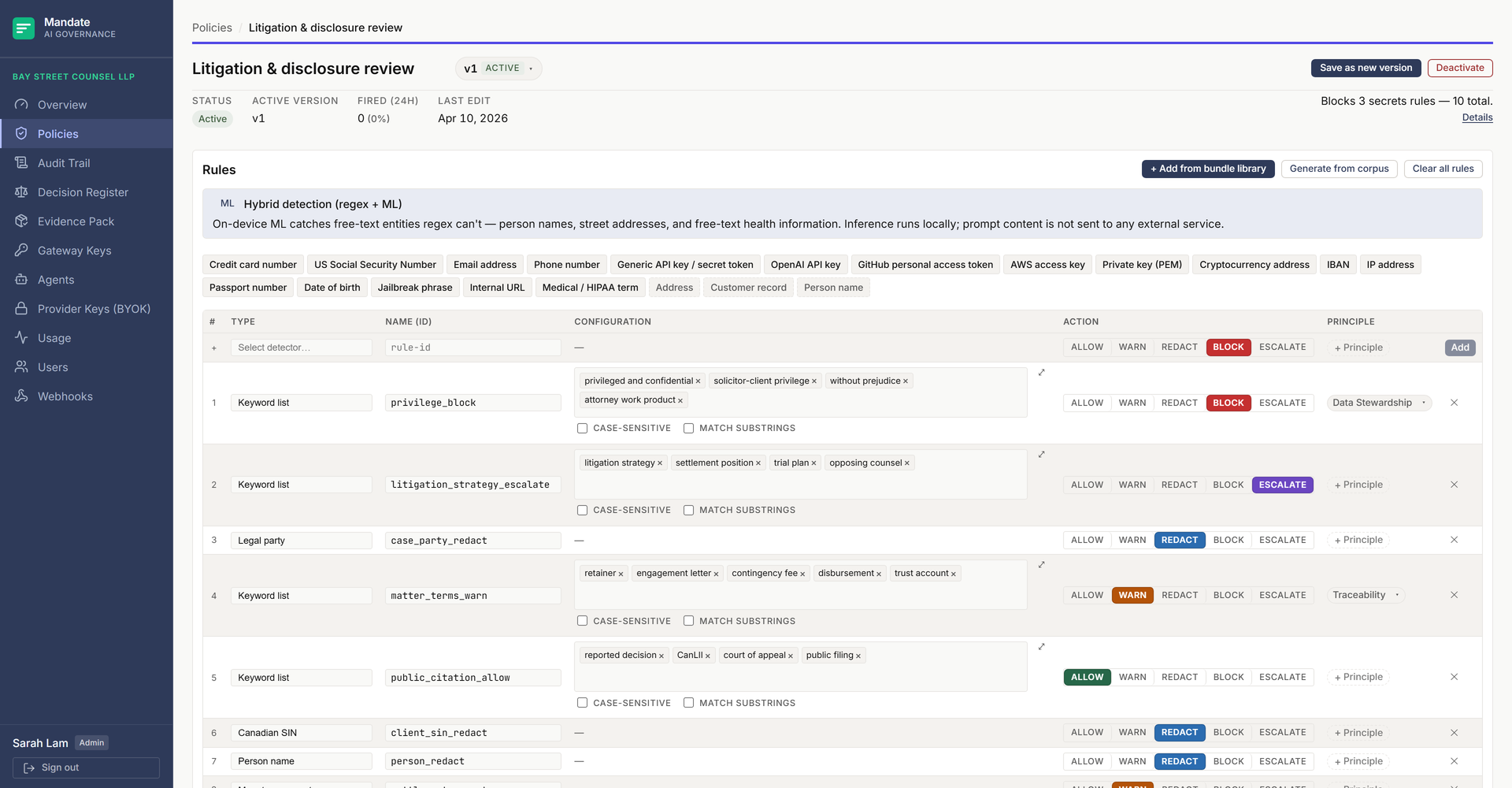
Your configured rules apply at the point of use (allow, warn, redact, block, or escalate) based on sensitive data patterns, tool usage, and content classification.
-
Agent governance
Each AI agent runs under its own named identity. Mandate reads the tool calls it makes, applies the same rules your people get, and writes every agent action to the same tamper-evident record.
-
Tamper-evident audit trail
Structured audit records for every request: user, tool, policy rule, action, timestamp. Hash-chained and exportable. The record your auditor can actually verify.
-
Canadian-hosted infrastructure
Runs in Canada today on Canadian-owned infrastructure, under a legal jurisdiction your counsel can evaluate before you sign. The architecture isn’t tied to one country.
The pilot program
30 days. Written criteria.
One administrator sets it up in an afternoon, nothing deployed to employees. Criteria agreed in writing before day one; if the pilot doesn't meet them, we tell you why.